Paolo Bulletti and Leonardo
Leonardo da Vinci has been a member of my family since I was a teenager. My father was the Art Director of the Giunti Publishing Group when, in the mid-1960s, the publisher was appointed to print, in fac-simile, Leonardo’s codes.
A prestigious work that collects all the Leonardian’s codes by reproducing the original sheets in a perfect way from every point of view: materials, printing, binding.
Since then, for the rest of his life, Leonardo has been a permanent presence next to him, and to us. The infinity of topics that Leonardo dealt with, gave my father the opportunity to tell us stories and anecdotes from the life of the Tuscan genius.
In those years at home, during meals, often, we were not four, but five because Leonardo was obviously sitting there among us.
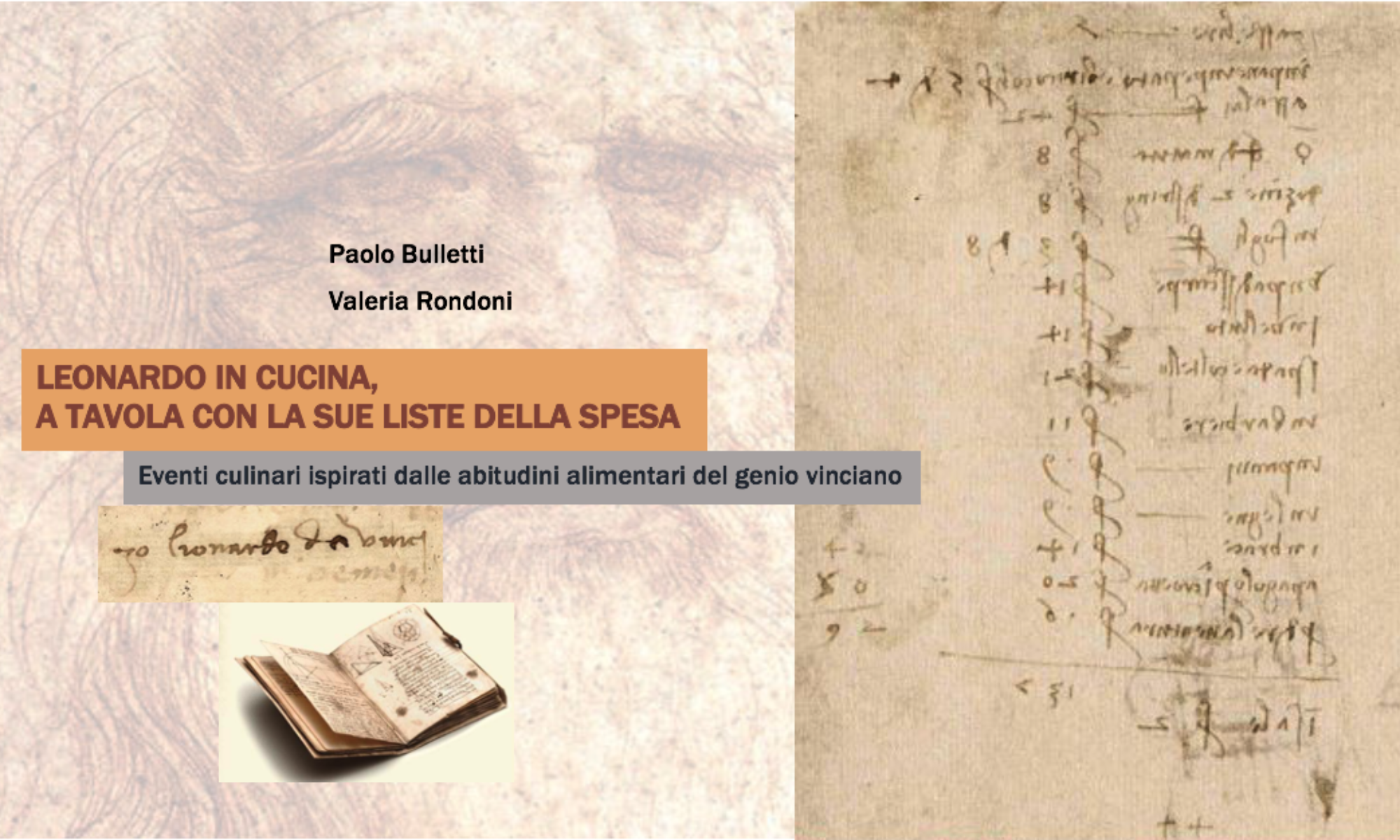
My interest focused more on manuscripts than on paintings or inventions, also because I was used to see those printed sheets coming in and out, so when in 2015, following the renewed attention to Leonardo’s Milanese vineyard, in conjunction with the food themes addressed at the Expo, my father told me about the shopping lists and eating habits described in the codes, the Leonardo’ spark lighted another passion of mine: the kitchen.
I began to have an attraction for the stove around the age of thirty. At first the traditional Tuscan cuisine and then the Mediterranean one, I felt inside me the impulse of the medieval innkeeper who cooks in the pots of his tavern, food rich in flavor that would have left a memory and a comfort in the passing customers.
My paternal grandfather was a chef for noble families and in hotels. My maternal grandmother, after the war, was for many years a cook in a public company. I grew up in the midst of recipe books, cooking tests and delicious food.
Following my father’s stories about Leonardo’s shopping lists, along with my wife, we begin research on the codes.
As we find the shopping lists we take small steps in Leonardo’s daily life and new dishes are born in my head.
I understand that I do not want to become a chef, I am passionate about my profession as an architect and lecturer, but I am attracted to discovering the flavors and foods that Leonardo most likely tasted, and make them known to others. Leonardo is, and remains, my source of inspiration. I rediscover old ingredients, old spices, Renaissance gastronomic culture and I try to make them attractive today.
This 2019, with the celebrations of the five hundredth anniversary of his death, has led to invitations to cook on private and public occasions, in business meetings and marketing events, with what we could have found in Leonardo’s home and tell of how, at that time, he was an attentive connoisseur of the relationship between food and health.
The Leonardo’s “diet”, based on simple, seasonal and zero km foods, interprets topical issues and will not cease to fascinate in the future.
Valeria Rondoni and Leonardo
I discovered Leonardo da Vinci at age 16 during a visit that I decided to do on my own at the Uffizi Gallery in Florence. Looking at the painting of the “Annunciation” I found many symbols that would have bound me to him forever and that brought me, shortly thereafter, to read a book, quite impossible to find, dedicated to his literary writings.
A wonderful text edited by the great Leonardist Augusto Marinoni that I would have found many years later also in the library of my father-in-law, art curator of the facsimile print of Leonardo’s manuscripts for the publisher Giunti, and artist himself.
I used to see him at home or at his work desk at the publishing house, and we spent together, in the last 35 years, many hours talking about Leonardo and delving into his many artistic, scientific and personal aspects flipping through codes, prints and all sorts of publications, which he was used to collect carefully.
In 2015 during the Milan Expo, it happened to discuss about food, the theme of that international event, and about how Leonardo thought and advised, about 500 years ago, on food and its relationship with health, as could be deduce from his shopping lists.
I began an increasingly in-depth research on manuscripts, facilitated by the availability of facsimile printed codes that my father-in-law possessed, and by his teaching to read Leonardo’s reversed writing using a mirror.
I was surprised to discover lists of foods in pages of study on the flight of birds, next to architectural schemes or mathematical calculations, but which gave the idea of the importance that Leonardo placed on nutrition in his daily life.
I then found advice on how to arrange the spaces in a family home, plan the pantry and vegetable garden, design kitchen tools or grind wheat to produce flour and appliances to improve cooking, as well as important information on how to grow vines and make wine, press the olives to get the oil and also some of his recipes.
In the shopping lists there are bread, meat, wine, salad, soup, eggs, herbs and many other ingredients which, together with further research on medieval and Renaissance cuisine, my husband then started to combine in recipes that are careful to reproduce the flavors of those times. The work in pairs continues with enrichments and occasions of events in which we are thrilled by the enthusiasm of those who taste these dishes, thinking that Leonardo would have used the same ingredients.
You fall in love with Leonardo, and it lasts forever.
Bios
Paolo Bulletti is a licensed architect, a property consultant and an Adjunct Professor at Texas A&M University. With over 35 years of practice experience, he carries out his activities on private residential projects, landscaping and consultancy in the real estate field, acting as a valuator and facilitator in the forming of financial partnerships. Paolo serves as an Architectural design professor at Texas A&M University where he explores issues pertaining the relations between contemporary architecture and historical towns, maintaining a research focus on urban landscape design. He has been a Professor at the School of Architecture of the University of Florence, at Art Center College (Europe), at SACI Studio Art College International where he has been the Head of the Architecture & Design Department for over 10 years. Paolo has published extensively on sustainable and green architecture and has curated exhibitions and events. He is one of the few Italian members of the RIBA Royal Institute of British Architects.
Valeria Rondoni graduated from the University of Florence with a second level master degree in History.
She has been a Professor specialized in Modern and Contemporary Art at Richmond College University, at Studio Art College International (SACI) and at Polimoda in Florence.
In more recent years she has been involved in many cultural and social projects, both in Florence and in Milan, working with art dealers and contemporary artists.
A prolific scholar, Valeria has lectured on art and theosophical topics for the last 25 years.
At the present she is an advocate and contributor to the public understanding of the new modality of healing in the quantum field in Homeopathy LM potency and involved in projects with its commercial aspects related to the application of the new Phisics to industrial products.